 Senate Square Society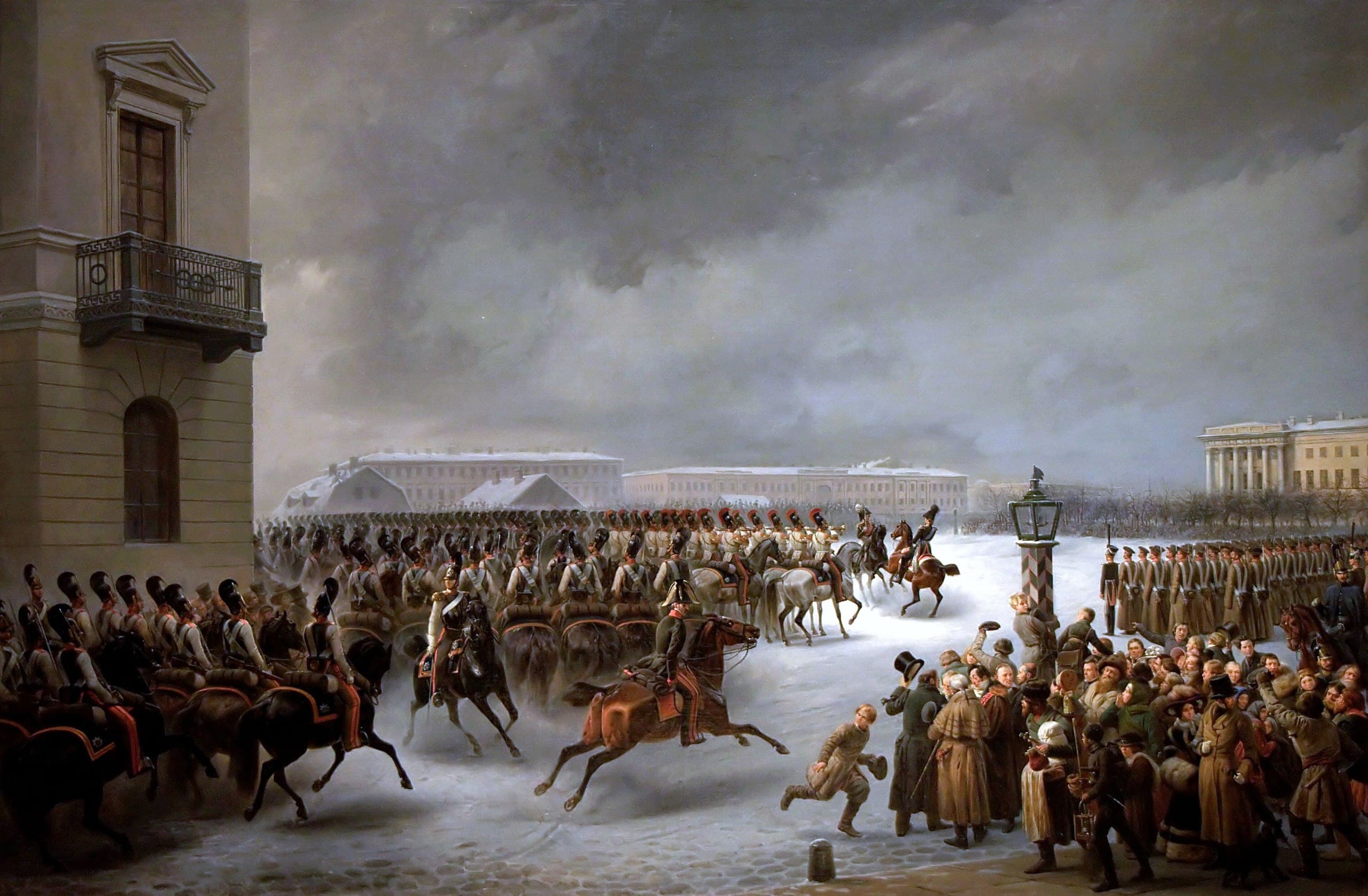
December 26, 1825 — Senate Square, St. Petersburg
The Decembrists
The first organized movement in Russian history to demand constitutional government — three thousand soldiers who stood in a frozen square against an empire, and the idea that outlived them.
The Interregnum
The men who would become known as the Decembrists were not outsiders. They were decorated officers of the Imperial Guard, many of them aristocrats from Russia's oldest families, veterans of the Napoleonic Wars who had chased Napoleon's army from Moscow to Paris. In France and the German states they saw societies governed by law rather than by the whim of an autocrat — and they returned home to an empire built on serfdom, censorship, and the lash.
Beginning in 1816 they organized in secret — first the Union of Salvation, then the Union of Welfare, and finally two coordinated conspiracies: the Northern Society in St. Petersburg, which favored a constitutional monarchy, and the more radical Southern Society under Colonel Pavel Pestel, which demanded a republic.
Their moment came unexpectedly. Tsar Alexander I died suddenly in December 1825, leaving no son. The throne should have passed to his brother Constantine — but Constantine had secretly renounced it two years earlier. For three weeks the empire hung between two emperors: the army had sworn to Constantine, who refused to rule, while Nicholas, distrusted by the Guards, prepared to take the crown. A second oath, to Nicholas, was set for December 26. The conspirators resolved to act in the gap.
The Day
December 26, 1825 — December 14 by the old Russian calendar, the date by which history remembers the rising.
Dawn
The Senate and most Guards regiments swear allegiance to Nicholas I at first light. The conspirators' plan — to force the Senate to proclaim a provisional government before the oath — is obsolete before the day begins.
Late morning
Officers of the Moscow Life-Guards Regiment, led by Mikhail and Alexander Bestuzhev, refuse the new oath and march roughly 800 men to Senate Square, forming a battle square beside the Bronze Horseman, Falconet's monument to Peter the Great.
Midday
The Guards Marine Equipage and the Life-Grenadiers join the rising, bringing rebel strength to some 3,000 soldiers. Thousands of onlookers crowd the square. The troops shout for “Constantine and Constitution.” Prince Trubetskoy, elected “dictator” of the rising, never appears — the rebels stand leaderless in the cold.
Early afternoon
Count Mikhail Miloradovich — governor-general of St. Petersburg and a celebrated hero of 1812 — rides out alone to persuade the soldiers to disperse. Pyotr Kakhovsky shoots him from the ranks; he dies that night. The rising has passed the point of return.
Afternoon
Nicholas masses some 9,000 loyal troops around the square. A charge by the Horse Guards falters on the ice and is repelled by musket fire. An appeal by Metropolitan Seraphim is turned away. For hours the two forces face each other in the freezing dusk.
Dusk
With daylight failing, Nicholas orders his artillery to fire. Grapeshot tears through the square. The rebel formation breaks; hundreds are killed. Soldiers fleeing across the frozen Neva drown when cannon fire shatters the ice beneath them.
Night
Arrests begin across the capital. Ryleyev and the other leaders are taken to the Peter and Paul Fortress, where the new Tsar personally directs interrogations. Days later, the Southern Society raises the Chernigov Regiment in Ukraine; it is crushed by artillery within a week.
Who They Were
Five hundred and seventy-nine men were investigated in the months that followed; two hundred and eighty-nine were found guilty. They were poets and colonels, princes and sub-lieutenants — a generation of Russia's best, wagered on the conviction that their country deserved a government of laws.
Kondraty Ryleyev
Poet; leader of the Northern Society
Executed 1826
Pavel Pestel
Colonel; leader of the Southern Society, author of the republican Russkaya Pravda
Executed 1826
Sergei Muravyov-Apostol
Lieutenant colonel; led the Chernigov Regiment rising
Executed 1826
Mikhail Bestuzhev-Ryumin
Sub-lieutenant; emissary of the Southern Society
Executed 1826
Pyotr Kakhovsky
Fired the shot that killed Count Miloradovich
Executed 1826
Nikita Muravyov
Author of the Northern Society's draft constitution
Exiled to Siberia
Prince Sergei Trubetskoy
Elected “dictator” of the rising; failed to appear on the square
Exiled to Siberia
Prince Yevgeny Obolensky
Took command on the square in Trubetskoy's absence
Exiled to Siberia
What They Sought
The Decembrists were not palace plotters trading one tsar for another — Russia had seen plenty of those. They were something the empire had never faced: a movement that sought to change the system itself.
Nikita Muravyov's draft constitution for the Northern Society envisioned a federal state on partly American lines — a bicameral legislature, an executive bound by law, and power devolved to the provinces. Pestel's Russkaya Pravda went further: a unitary republic, the abolition of the estates, and land distributed to the peasants who worked it. They disagreed fiercely about the destination; they agreed absolutely that autocracy and serfdom had to end.
- The immediate abolition of serfdom — the emancipation of more than twenty million enslaved peasants
- A written constitution binding the sovereign to the law
- Representative government — a constitutional monarchy for the Northern Society, a republic for the Southern
- Equality of all citizens before the law, and trial by jury
- Freedom of the press, of assembly, and of conscience
- An end to the brutal military colonies and twenty-five-year conscription
The Price
On July 25, 1826, five men — Ryleyev, Pestel, Muravyov-Apostol, Bestuzhev-Ryumin, and Kakhovsky — were hanged at the Peter and Paul Fortress. The ropes broke under three of them, and they were hanged a second time. More than a hundred others were stripped of rank and title and marched to Siberian penal labor.
What followed became one of the most storied episodes in Russian memory: eleven wives — princesses among them — renounced their titles, their property, and in some cases their children to follow their husbands into Siberian exile. Maria Volkonskaya and Yekaterina Trubetskaya crossed five thousand versts of winter road to live at the edge of the mines. Their devotion kept the Decembrists' memory alive through thirty years of enforced silence under Nicholas I.
The Legacy
The rising failed in an afternoon; the idea did not fail at all. From exile, Alexander Herzen — who as a boy swore an oath on the Sparrow Hills after watching the executions' aftermath — founded the Russian free press abroad and named his almanac The Polar Starafter Ryleyev's. Pushkin smuggled verses to his exiled friends in the Siberian mines. Every Russian movement for law and liberty since — the reformers of the 1860s, the constitutionalists of 1905, the dissidents of the Soviet era, the protest generations of this century — has traced its lineage to the square.
“From a spark, a flame will ignite.”
— Alexander Odoevsky, Decembrist, replying in verse from the Siberian mines to Pushkin, 1827
Their Cause and Ours
The Senate Square Society takes its name from that frozen square. The Decembrists' program — an end to bondage, equality before the law, representative institutions, a press that cannot be silenced — is, two centuries later, still the unfinished agenda of the region we study. Their fate is still the fate of those who pursue it: today's Russian dissidents face the same prisons, the same exile, and the same official silence, and today's émigrés carry the flame abroad just as Herzen once did.
We promote kinetic action as a means to create democratic institutions — because the Decembrists did not merely write about liberty. They stood in the square for it. Our name reflects the fact that we stand with all those, then and now, who are willing to fight for change.